Book Reviews
We thought you might welcome reviews of some history books we have found interesting.
Please let us know if there are any you would like to recommend – whether it be local, national, regional or world, from ancient to modern. Please send to: bshschair@btinternet.com.
The Fortunes of Francis Barber : The Story of the Enslaved Jamaican Who Became Samuel Johnson’s Heir, by Michael Bundock, Yale University Press, ISBN: 978-0300260960 (2015)
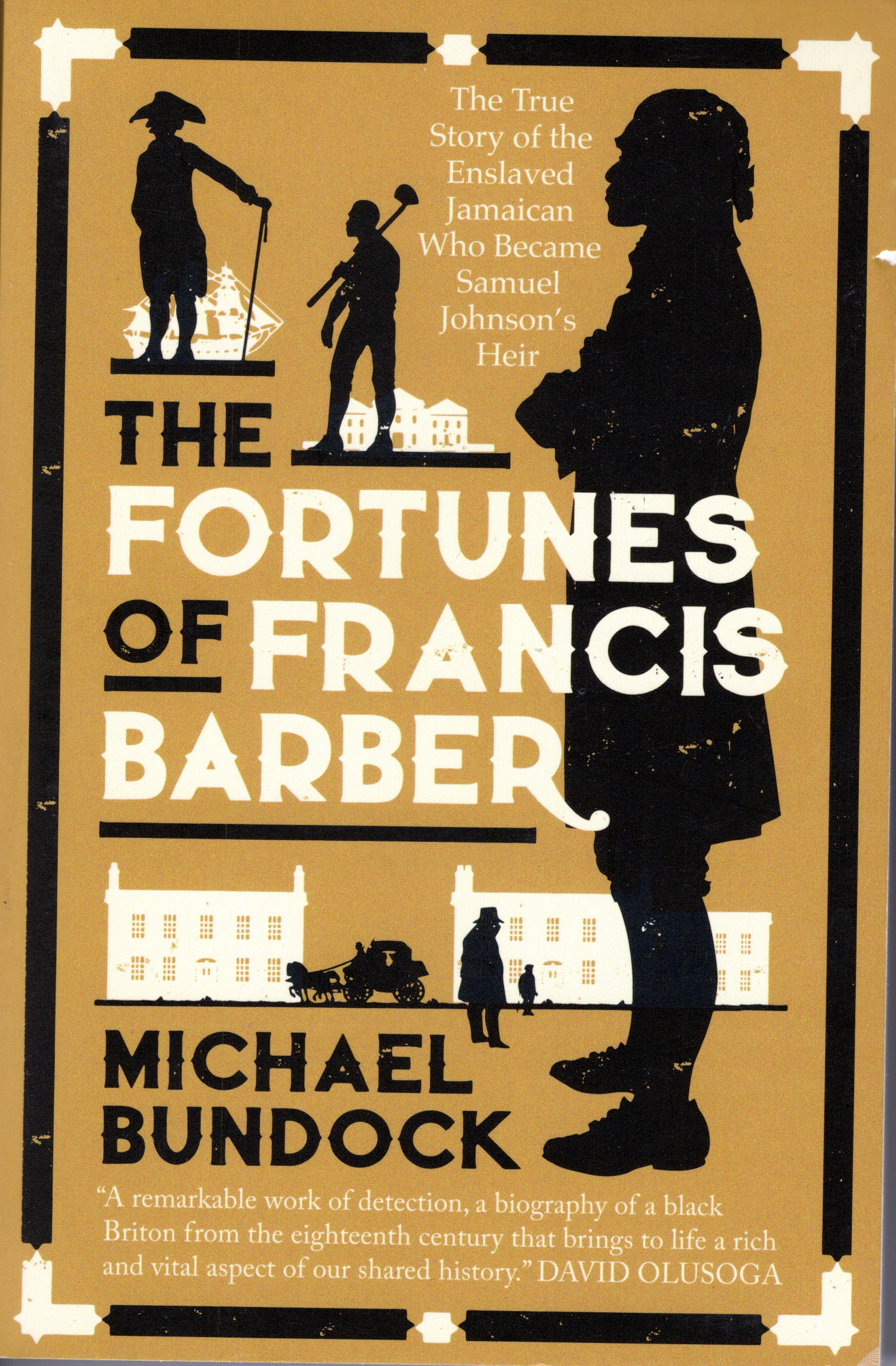
This compelling and sensitive biography, the first to be written in over a hundred years, clearly describes what it was like for a free black man to make his way in eighteenth century London. Born a slave, then named Quashey, Francis Barber arrived in London in 1750, brought by his owner, who had sold his sugar plantation in Jamaica. Soon afterwards, he was baptised and named Francis Barber. After some years of education in Yorkshire, he went to work for Samuel Johnson, a close friend of his previous owner, who was compiling a dictionary of the English language. What a strange sight they must have made walking and talking in the streets of London: the slight ten year old Barber and his tall, middle-aged master, who was usually described as weird and ugly. In time, Barber longed for independence and joined the Royal Navy; but he returned to Johnson some years later.
By this time, Johnson was more financially stable and wanted to complete Barber’s education. In the Gentleman’s Magazine, Johnson read this comment: “The famous grammar school at Bishops Stortford produced a succession of learned and virtuous men…”
Barber was sent to the school in what was Windhill House, close to St Michael’s Church. But the school was losing money and he left in 1771 to return to Johnson. The school closed a year later.
It is distressing to learn that throughout these years in England, there were still auctions taking place for the sale of young negroes to be re-enslaved in the colonies. This fear must have hung over Barber. In time, he married a white woman and they and their children continued to live with Johnson in London. There is no doubt as to the great affection between Francis Barber and Samuel Johnson, who remained a father figure in his life and always felt a deep responsibility for him throughout his own worries and ill health. Barber’s children – including a son named Samuel – brightened Johnson’s gloom until the day he died, leaving Barber an annuity of £70.00. The Barber family moved to Lichfield, in Staffordshire, where Barber taught in the village school. He is buried in St Mary’s churchyard, Stafford.
There is a huge wealth of well-researched detail in this biography, which is full of humour, social comment, reflections on slavery and anti-slavery movements. But, above all, it is a striking portrait of a young boy who was shown compassion as he forged his own life in a society that had once enslaved him.
Pauline Francis, February, 2025 – with thanks to our member, Marie Rhodes, who has donated her copy of the book to BSHS. I am reviewing this book to mark the installation in Windhill of a blue plaque in Francis Barber’s memory. The plaque reads:
“Francis Barber. C 1742-1801.
Freed slave, valet, secretary and schoolmaster, lodged and attended the Grammar School here.”
The Dictionary People, Sarah Ogilvie, Vintage, ISBN: 978-1529922578 (2024)

“What do three murderers, Karl Marx’s daughter, and a vegetarian vicar have in common? They all helped to create the famous Oxford English Dictionary, first published in 1928.” – This is an entertaining and brilliantly researched book which was long listed for the Women’s Non-Fiction prize this year. Sarah Ogilvie plunders numerous archives to reveal the personal stories of some of the early unpaid contributors of words to the Oxford English Dictionary, often thought to have been compiled solely by academics. From the very start, an appeal was made for new words from the public. Many of those who responded were ‘ordinary’ people with limited education. Many were women seeking an intellectual outlet. It’s an astonishing book, telling us not only why, and how, certain words were chosen, but about the people behind the words, providing an endlessly fascinating social history of the nineteenth and early twentieth centuries.
Each chapter is headed by a letter of the alphabet. I laughed out loud at H for Hopeless Contributors. This is an easy-to-read and intelligent book in which Sarah Ogilvie brings a complicated history to life.
The Walls have Ears: The Greatest Intelligence Operation of World Word II, Helen Fry, Yale University Press, ISBN: 978-0300254853 (2019) – an astonishing story of wartime espionage at Trent Park, Middlesex
Lost and Found – Journey to a Forgotten Railway, David Grindley, Slowcoach Publishing, ISBN: 978-0956412812 (2016) – an exploration of the lost Bishop’s Stortford to Braintree Railway.
Hertford in 50 Buildings, Paul Rabbits & Peter Jeffree, Amberley Publishing ISBN: 978-1398103788 (2023) – a fascinating exploration of Hertford, well illustrated with colour photos. Who would have guessed Hertford had so many – a challenge for Stortford?
Winters in the World: A Journey Through the Anglo-Saxon Year, Eleanor Parker, Reaction Books, ISBN: 978-1789147735 (2023) – How the pagan Anglo-Saxon natural year was adapted to spread Christianity; lyrical, translations Old English poetry.
The Viking Great Army and the Making of England, Dawn Hadly & Julian Richards, Thames & Hudson, ISBN: 978-0500296622 (2021) – Fascinating read about the Vikings and how their army moved around England – the role of detectorists in finding their camps.
The Anglo-Saxon World, Nicholas Higham & Martin Ryan, Yale University Press, ISBN: 978-0300216134 (2013) – Compendious and well-illustrated about the Anglo-Saxons – well written.
Digging up Britain: A New History in Ten Extraordinary Discoveries, Mike Pitts, Thames & Hudson, ISBN: 978-0500296127 (2019) – Descriptions of key English archaeological sites (including Stone Henge) – well written and a great overview of historical events 400,000 BC to AD 1000.
Castle in Context: Power, Symbolism and Landscape, 1066 to 1500, Robert Liddiard, Windgather Press, ISBN: 978-0954557522 (2005) – New views on the purposes of castles from the Norman era, what they were designed to do and the power they projected.
The Medieval Castle in England and Wales: A Social and Political History, N J G Pounds, Cambridge University Press, ISBN: 978-0521383493 (1991) – Good overview with a lot of interesting detail, how they were built, maps, sketches, data.
The Road, Christopher Hadley, William Collins, ISBN: 978-0008356729 (2024) – A fascinating study of a local Roman road leading from Braughing to Great Chesterford, by a local author.
Brewers in Hertfordshire – A historical gazetteer, Dr Allan Whitaker, University of Hertfordshire Press, ISBN: 978-0954218973 (2006) – Brewing and its associated activities have been important industries in Hertfordshire for centuries. After an introduction to the brewing process and an overview about the development of the industry in the county, the gazetteer section visits each significant town in Hertfordshire, detailing the brewers who worked there and what remains to be seen today.
Rivers Nursery of Sawbridgeworth: The art of practical pomology, Elizabeth Waugh, Rivers Nursery Site and Orchard Group, ISBN: 978-1904851325 (2009)